
This sky plane grass worm paper printable is a free four-line handwriting system that gives early writers a visual guide for exactly where each letter belongs on the page — including letters with tails.

If you’ve spent any time teaching handwriting, you know that descending letters are the hardest part. Where does the g go? The y? Why does the p hang below the line? Standard three-line paper doesn’t give kids a target for those letters. Sky plane grass worm paper does.
It’s one of those tools that seems simple until you watch a student suddenly understand why their g looks wrong — and then fix it on their own.
Download the free PDF in portrait or landscape orientation below, or open the Canva template to adjust the line colors before printing.
➡️ For the full range of printable handwriting paper options, the handwriting paper collection has wide-ruled, college-ruled, dotted, numbered, and specialty formats.
What is Sky Plane Grass Worm Paper?
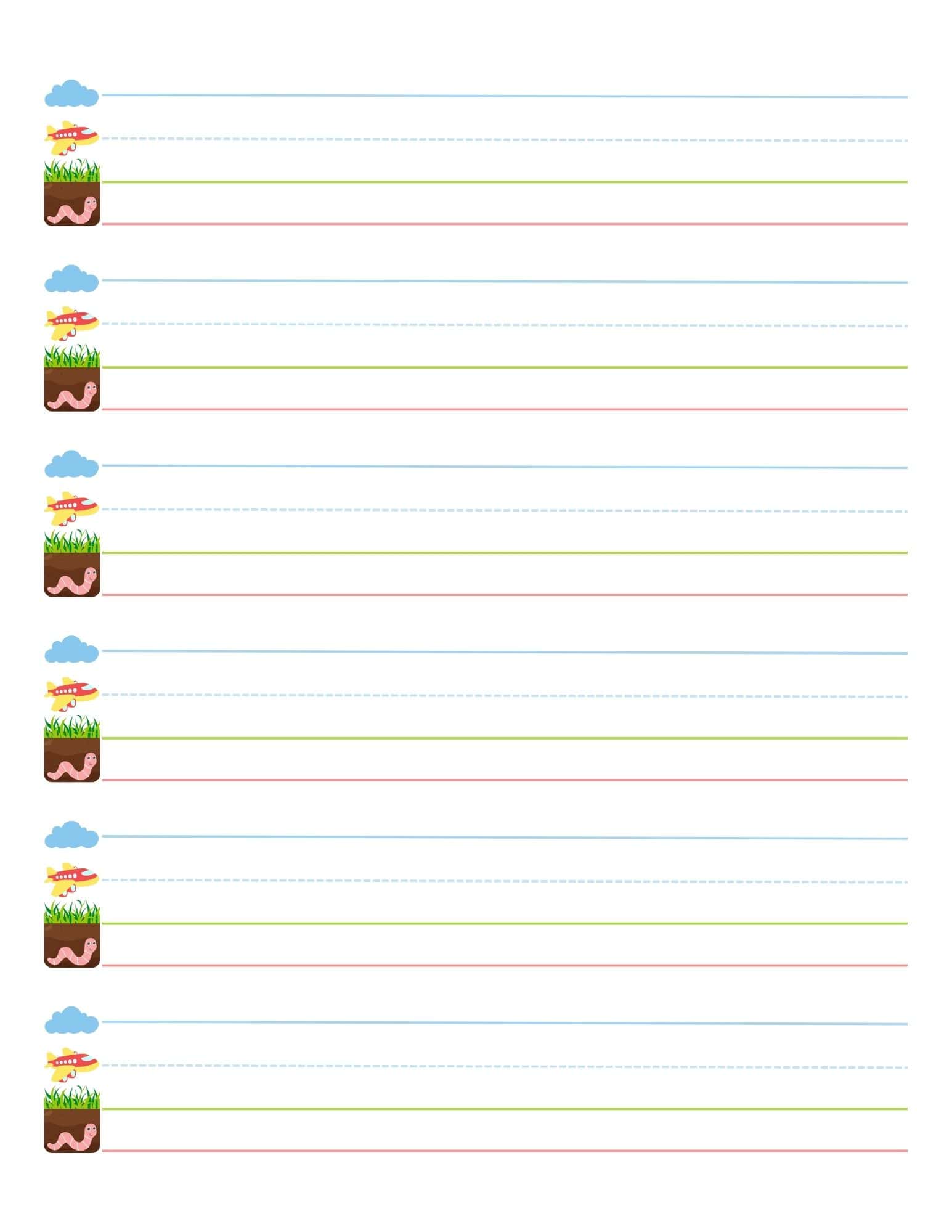
Each line is color-coded (it also works in black and white) and has an icon of the sky, a plane, grass, or a worm.
- 🌟 Sky Line: Represents the sky and is where tall letters (like “b,” “h,” “k,” “l,” and “t”) begin.
- ✈️ Plane Line: Symbolizes the plane in the air and is where short letters and circles (such as “a,” “c,” and “e”) start.
- 🌱 Grass Line: The baseline where all letters rest.
- 🐛 Worm Line: An additional line below the grass line, specifically for letters with tails (like “g” and “y”).
The genius of this paper is the added worm line. This helps students write letters with tails, which can be confusing on traditional 3-line handwriting paper.
Using the Oral Cues in the Classroom
The real power of sky plane grass worm paper is the scripted language it gives you.
While students write, you can say things like:
- “The letter b starts at the sky and comes all the way down to the grass.”
- “The letter g starts at the plane, goes down through the grass, and hangs down to the worm.”
- “The letter a lives between the plane and the grass — it doesn’t touch the sky.”
- “The letter y starts at the plane and has two tails that reach down to the worm.”
Every letter has an address. That consistency helps students self-correct — they can ask themselves ‘where does this letter live?’ instead of just guessing at the line.
The best part is that you can keep using this vocabulary after you transition to regular paper. The worm line icon is gone but the language sticks. Students who’ve used sky plane grass worm paper continue to reference the line names on standard paper because they’ve internalized the spatial framework.
| Pro Tip: Introduce the system with the color version first. The visual distinction between the four lines is much clearer in color. Switch to grayscale once students know all four names — usually after 1 to 2 weeks of daily practice. |
What’s Included:
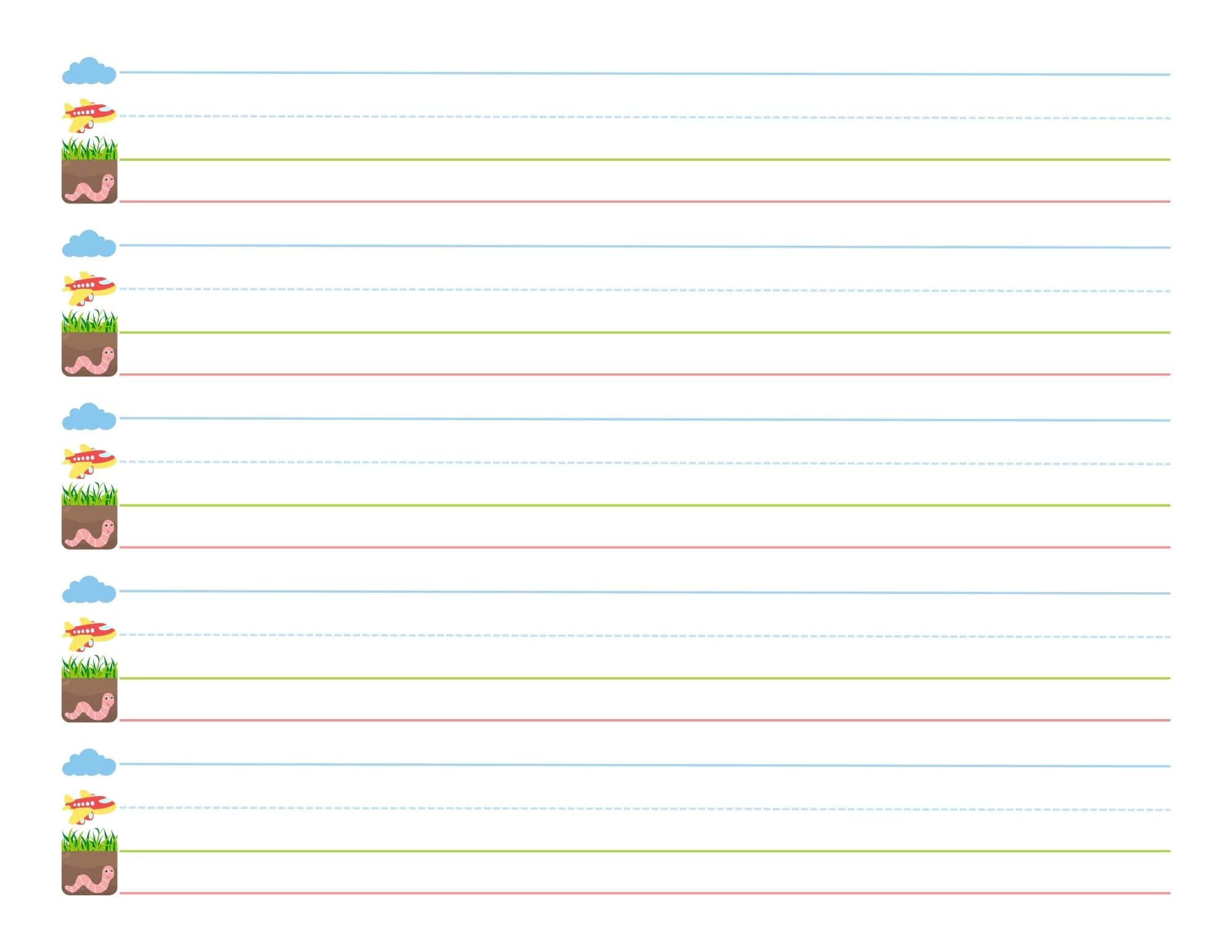
- 2 pages — one portrait orientation, one landscape orientation
- US Letter, 8.5 x 11 inches
- Color version and grayscale version of both orientations
- 6 line sets in portrait; 4 line sets in landscape
- Half-inch spacing between lines, three-quarter inch between rows
- Soft enough colors that pencil writing is still clearly readable
- PDF download and editable Canva template
Who This Printable Handwriting Paper Works Best For
- Kindergarten and first-grade teachers introducing manuscript handwriting for the first time
- Second-grade teachers reinforcing letter formation for students still struggling with descenders
- Homeschool families looking for free printable handwriting paper with more structure than standard lined sheets
- Occupational therapists working with students who need explicit spatial cues for letter placement
- Parents supporting letter formation at home alongside classroom instruction

Frequently Asked Questions
What grade level is sky plane grass worm paper for?
Most commonly used in kindergarten through second grade for manuscript (print) handwriting instruction. It’s also useful for older students still working on specific letter-formation errors, and for any learner who benefits from explicit spatial cues.
Occupational therapists use it across a wider age range because the named line system works for anyone learning or relearning letter placement.
How is this different from regular primary handwriting paper?
Standard primary handwriting paper has three lines: a top line, a midline (sometimes dashed), and a baseline. Sky plane grass worm paper adds a fourth line below the baseline — the worm line — which gives students a clear visual target for descending letters.
That’s the main difference. The named lines and matching icons also create a consistent vocabulary for oral cues during instruction, which standard three-line paper doesn’t provide.
You Might Also Like:

FREE Printable Calendar Numbers 1-31
Free Printable Play Money PDF | For Kids, Classroom & Board Games

Sky Plane Grass Worm Paper: Free Printable Handwriting Paper K-2
Can I use this in black and white?
Yup. Both orientations print cleanly in black and white on any standard printer. The grayscale version is great for everyday practice once students know the four line names.
⭐ For introducing the system to a group for the first time, the color version is recommended — the visual distinction between the four lines is noticeably clearer, especially for kids who are still learning which line is which.
Is there a version with wider spacing for younger writers?
The portrait orientation has half-inch spacing between lines, which is the standard for early elementary handwriting paper.
If you need wider spacing, open the Canva template and adjust the line height before printing. The landscape orientation has 4 line sets on the page, which gives you more room per writing attempt if you’d rather have fewer lines and more space.
More Printable Handwriting Paper for Kids
The handwriting paper collection has every style:
- Wide-ruled paper — for students who need more space between lines
- College-ruled paper — for older students moving to narrower spacing
- Numbered lined paper — numbered lines for structured writing activities
- Dotted lined paper — for Montessori-style tracing and letter practice
For a full classroom display, pair the printable handwriting paper with printable calendar numbers, printable days of the week, and printable months of the year.